|
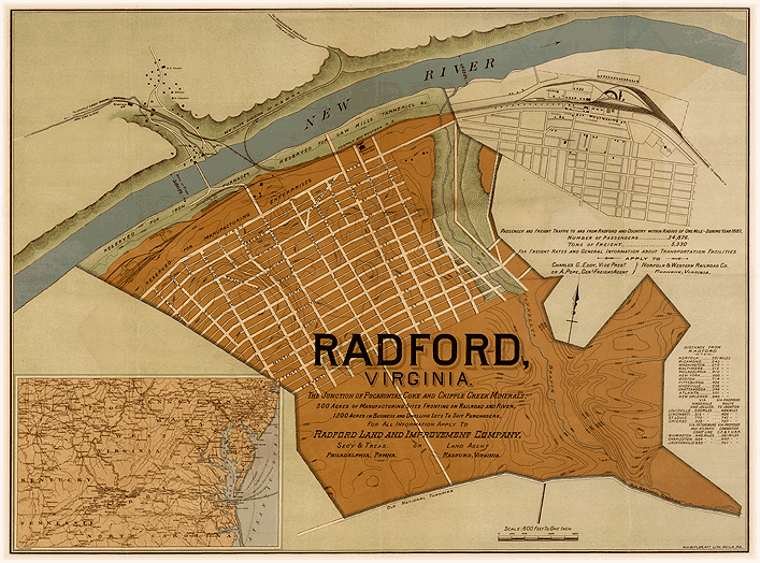
Radford, Virginia originated as a railroad town in 1886. At this
time, the town was known as Central Depot. Radford was incorporated
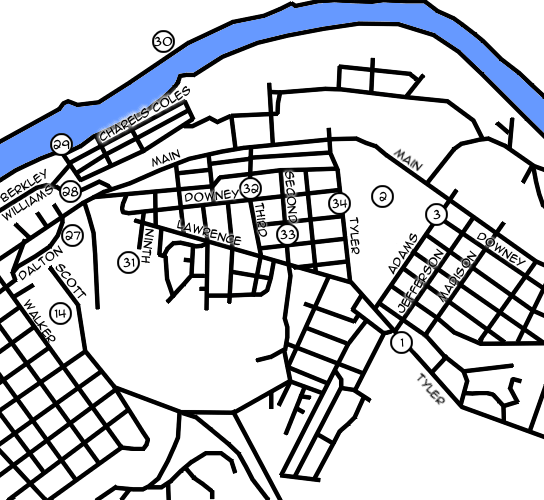
in 1887, and in 1892 Radford became a city, named for Doctor John
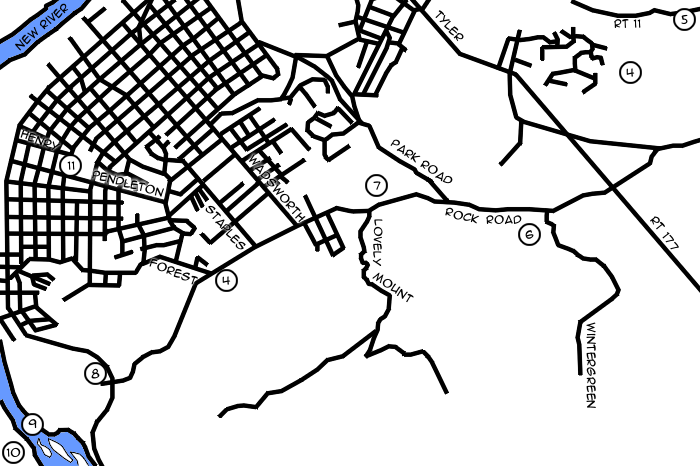
Blair Radford, a prominent citizen.
1. Halwyck: Located at 915 Tyler Avenue, this is the
former home of Governor James Hoge Tyler and his family. The Tyler
family moved into the home on April 3, 1891. Bricks for the home
were kilned along with those for the Presbyterian Church. The name
Halwyck was given to the home by Governor Tyler's wife, whose
ancestors' home in Ireland was named Bally Halwyck, meaning
"beautiful home". The three story house has approximately 19 rooms
and several windows of colored Victorian glass. Governor Tyler was
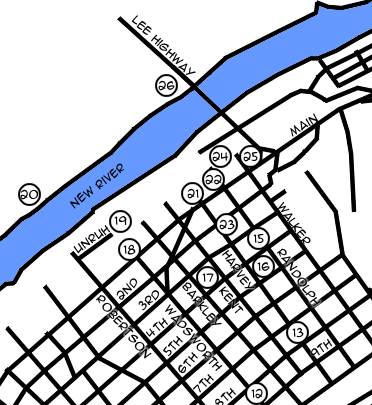
active in the business and political affairs of the city, and served
as Governor of Virginia from l898 to 1902. He lived in the home
until his death in 1925.
2. Radford University: Founded in 1910 as the State
Normal and Industrial School for Women, this became a state teachers
college in 1924 and awarded its first bachelor of arts degree in
1935. The first president, Dr. John McConnell, served for 25 years.
In 1964, Radford was authorized to grant the master of science
degree. The current president, Dr. Donald Dedmon, came to Radford in
1972. That same year, after years as a women's college, Radford
became coeducational, and in 1979 Radford was granted university
status by the General Assembly. Today, Radford University is an
institution which serves more than 9000 students at the
undergraduate and graduate levels.
3. La Belle Inn: Originally located on what is now
the Radford University campus, in front of McGuffey Hall and facing
Adams Street, this inn was built to house railroad employees. La
Belle Inn was later utilized as Radford's first hospital, Valley
View Hospital, and was finally used as a dormitory for Radford
College. The inn was torn down in 1920.
4. Wilderness Road: Also known as the National
Turnpike, and locally known as the Ingles Ferry Road, the Wilderness
Road in the Radford area can be traced from the State historical
marker on Route 11 at its intersection with Route 688. Today remains
of the run along the creek to the right of route 11 as one travels
toward Radford. The trail crosses the highway near the Havin House,
then courses behind the George Harvey home along the edge of the
College Park section and meets Tyler Avenue at the intersection of
Tyler Avenue and Auburn Avenue (Route 688). The Trail then courses
through the woods behind the Super 8 Motel to Route 611, and passes
the Old Brick Church and the Lovely Mount Tavern on its way to the
Ingles Ferry. A major portion of settlers on their way to Kentucky
and Tennessee traveled this road. The road was a vital route in the
westward movement that continued through most of the nineteenth
century.
5. Haven House: Built in the 1790's, this home still
stands several hundred feet off Route 11 at the bend in Plum Creek
on the Eastern corporate limits of the City of
Radford..................
6. Old Brick Church: Founded in 1835 by a group of
Presbyterians led by Edward Hammet, this was the house of worship
for the Radford family. A red brick church was built here in 1840 on
land donated by Dr. Radford. It was long known as the Lovely Mount
Church...................................
7. Lovely Mount Tavern: "On this site a two story
log structure was built by John Heavin in 1796 on land purchased
from the Trigg family. The 'Lovely Mount Tavern' served as both home
for the Heavins and as an inn for travelers on the Wilderness Road.
In time a small settlement grew up around the tavern, including a
general store, blacksmith shop and saloon with residences for
several families and slave quarters. In 1827 the Heavens moved to
southern Indiana, selling the tavern to William Baskerville...
Under Baskerville's management the tavern prospered, and a post
office was established there in 1836 with the name Lovely Mount, and
with Baskersville as the first postmaster. The post office moved to
Ingles Ferry in 1837, returned to Lovely Mount in 1849, and finally
to Central City (Radford) in 1888. In l842 the property was
purchased by Dr. John Blair Radford and remained a social and
business center of the area until after the Civil War."
8. Ingleside: The original grant of land was issued
in 1748 and settled in 1758. The original home was located on The
Long Way Home to the right of the stage, a log structure and was
occupied by William and Mary Draper Ingles until their death in 1782
and 1815. The foundation is still at the site, the stones from the
chimney were used for the Mary Draper Ingles monument [see #11].
Ingleside was built between 1789 and 1790 by their son Colonel John
Ingles. The original structure is the section facing the river and
reflects the construction of the period with hewn logs fastened with
pegs and clapboard siding. The first addition, the present front,
was added in 1849, the second, a one and a half story section in
1880, a second story added in 1900 and a sleeping porch added about
1920. The property has remained in the Ingles family since 1748,
with seven generations living on the farm and six in the home.
[Buddy Jeffries, Bob Phillips 8 Reynolds Ft Leavenworth, KA
66072]........................
9. Ingles Ferry: Officially opened in 1762 when
William Ingles was granted a charter, this ferry may have run
privately for several years. At this site in 1760 was the first
rendezvous of Colonel William Byrd's expedition against the
Cherokees. In 1763, while returning from their last foray in the New
River region these indians were attacked by William Ingles and a
party of settlers. The ferry ran day and night to handle the heavy
traffic of pioneers on the Wilderness Road. In 1842, Thomas Ingles
built a covered bridge and a toll house beside the ferry. The
covered bridge remained in use for many years until it was burned by
Confederate soldiers on May 10, 1864 as they retreated after the
battle of Cloyd's Mountain. The ferry resumed operation until 1948.
The ferry, the ferryman's house, and later the Ingles Tavern became
the center of social life for the pioneers. Andrew Jackson is said
to have stopped here on several occasions.
10. Ingles Tavern: Built in 1772 by William Ingles,
the earliest portion of the tavern, located on the west bank of the
New River at the terminus of the Ingles Ferry, served as a tavern
and as Ingles' home. A two story addition containing a lobby,
barroom, and sleeping quarters for travelers was added to the
original one-and-a-half story log cabin. Other facilities at the
site included a blacksmith shop, stables, and store. A post office
was located there from 1837 until 1849 and served as a polling place
in Pulaski County.
11. Mary Draper Ingles Monument: Located just
inside the entrance to West View Cemetery on Fifth Street fifty
yards from the corner of Pendelton Street--this monument honors one
of Radford's most illustrious ancestors. The inscription reads,
"Mary Draper Ingles, born in Philadelphia, 1732, died at Ingles
Ferry, Va., 1815. The first white bride married west of the
Allegheny Mountains. Captured by the Indians, 1755, at Draper's
Meadow, now Blacksburg, Va., and carried to Ohio, escaping from her
captors, she made her way home in winter, alone, [with Mrs. Bingham,
ed] some eight hundred miles....this monument was erected of the
stones of the chimney of the cabin in which she lived and died after
her return from captivity..."
12. Wadsworth School: Located on the corner of
Eighth and Randolph Streets, this building still stands as a private
home. The school was West Radford's first, and was originally
situated on the corner of Sixth and Wadsworth. It was built by the
Radford Land and Improvement Company. When the building was no
longer in use as an institution of learning, it was moved to its
present location, (at that time, the old Radford fairgrounds). For
many years at the annual fair, the building was used as the exhibit
hall. The school was built as a frame structure; the brick siding is
a later addition. [which corner]
13. Harvey House: Situated on Harvey Street, at the
corner of Eighth Street, this house was built by the Radford Land
and Improvement Company, and was completed in 1892. It was first
occupied by the superintendent of the Lynchburg Foundry Company.
When the land boom ended, the house fell into the hands of a
caretaker, where it remained until 1900. In 1906 the house was
purchased by the late Lewis Harvey. All the woodwork on the first
floor, with the exception of the dining room, is solid cherry, and
the stairway, which has two landings, features hand carved panels.
At the top of the stairway are four semi-circular panels, each
representing a season. Lewis Harvey operated a transportation
business which rented horse drawn vehicles, buggies, and teams. The
home has its own stables which are located in the rear.
14. Grave of Dr. John Blair Radford: Located behind
the home at 403 Walker Street, it is accessible through the alley to
the left of the house. The family plot of the Radford family
contains the graves of many family members including Dr. Radford and
General Wharton......[bio Dr. Radford]...........
15. Presbyterian Church of Radford: Located on the
corner of Fourth and Randolph streets, this church was occupied in
1894. The Radford Presbyterian Church had its beginning in 1874 as
the New River Church with nine members. The manse was built across
the street from the church in 1908, and the Sunday School addition
was built in 1927. The beautiful stained glass windows, made by
William Coulter and Sons of Cincinnati, were installed in 1894.
16. Grace Episcopal Church: Located on the corner
of Fourth and Harvey Streets, the rectory was built in 1890. The
first services were conducted in 1857 at Arnheim, the home of Dr.
John Blair Radford. (see #27), by Rev. Frederick D. Goodwin. In 1892
W.J. Kenderdine drew the plans for Grace Chapel, and on May 8, 1892
the first service was held at Grace Church. The beautiful stained
glass windows were executed by Franz Mayer and three of the windows
(portraying "In the Garden", "The Annunciation", and "The
Transfiguration"), are signed by the artist. Mayer used the likeness
of Vladimir Lenin, the Russian revolutionary, as a model for the
Biblical characters in many of his works'. At Grace Church, a bald
man resembling Lenin appears in the window, depicting the visit of
Jesus to the Temple.
17. Former Home of the Late Governor John N.
Dalton: Located at 411 Fourth Street, this is the home of John
Nichols Dalton, former Governor of Virginia. John N. Dalton was born
in 1931. He attended the Radford City public schools, graduated from
the College of William and Mary and the University of Virginia
School of Law. He served as a member of the House of Delegates of
Virginia, 1966-1973; the Senate of Virginia 1973-1974; Lieutenant
Governor of Virginia, 1974-1978; and as Governor of Virginia from
1978-1982. He died in 1986.
18. Municipal Building: Located on the corner of
First and Wadsworth Streets, the former municipal building now
houses the Radford Police Department and the City Jail. The building
originally had a third floor and tower. These were removed after a
fire in 1950.
19. Glencoe: Located in the West End, behind the
Inland Motors parking lot, this was the home of Dr. Radford's
daughter, Nannie, and General G. C. Wharton. General
Wharton,.......[civil war record brief summary] was active in the
building of railroads. He built this home in 1870. After marrying
Dr. Radford's daughter, Wharton had been given the land by the
doctor for the construction of the couple's new home. The General
had attended the University of Pennsylvania, and, while there, lived
in a colonial home. When General Wharton built Glencoe, he copied
that architectural style.
20.
21. Delp Hotel: Located in Radford's West End, this
hotel served rail travelers from the turn of the century until the
l930's. Traces of the path leading from the West End Train Station
to the hotel entrance are still visible........................
22. Christ Lutheran Church: Located on the corner
of Harvey and Second Streets, the cornerstone of the present church
was laid in 1911. The congregation was formed in March of 1891 with
21 members, and the first building, located on Fairfax Street, was
dedicated in August of 1895. The original building, sold to the
First Baptist Church, later became part of the Radford University
campus. The cost of the plans for the present building was $10.00,
and the total cost of the church, including building, fencing,
grading and furnishings, was $3781. The windows are uniquely
beautiful. They were designed and fabricated in Munich, Germany and
installed in 1920.
23. Radford Inn: Located in the open parking area
across from the C & P Telephone office, this beautiful inn was built
by the N&W railroad. It was destroyed by fire on March 16,
1893............
24. West End Train Station: Located at the foot of
Randolph Street in the level area behind the First Street Pharmacy,
this stone passenger station was built in 1889-90 and remained in
use until 1931. The remnant of the path used by guests walking from
the station to the Delp Hotel extended diagonally from the station
to the Hotel entrance. The station was torn down in 1938. The stone
from the station was purchased by Grace Thomas, Radford's most
famous confectioner, and founder of Radford's Girl Scout Troop, for
her home. The Thomas house was built on the Pulaski side of the New
River at the corner of Route 11 and Fairlawn Road. Fragments of
stone are still present at the station site.
25. West End Flour Mill: Located on the corner of
Walker Street and Norwood at the site of the present Family Dollar
Store, the mill was built in 1906 by Jim Zull. It was operated as a
mill until 1932. After that date the building was used only as a
feed store. The site was sold and became the location of the first
Kroger store in Radford.
26. Saint Albans School: Located on the present
site of St. Albans Hospital, the preparatory boys school was built
before the turn of the century. The white brick building facing
route 11 is one of the original school buildings. The present
hospital was founded as the St. Albans Sanatorium in 1916, by the
late James C. King, who, as superintendent of Southwestern State
Hospital in Marion, realized the need for a private psychiatric
hospital.
27. Arnheim: Started in 1836 and completed in 1838,
this was the home of Dr. John Blair Radford. Clay for the bricks was
taken from the land where the high school now stands. The nails, of
antique design, were hand wrought. During the
War-Between-the-States, the house was shelled by Federal troops who
thought it was headquarters for the Confederate forces. In this
home, the first Episcopal services in Radford were held. In 1936,
the school board purchased the building to house Radford High
School's Home Economics Department.
28.
29. Indian Village: Complete with stockade, cooking
pits and burial sites, this Indian village was excavated in 1974 and
1975. A portion of the artifacts removed from this site are stored
in the Municipal Building, and the remainder are located at the
Virginia Landmarks Commission's Yorktown facilities.
30. Rockford: The name designated a ford on the New
River used as a river crossing. In the years before the inception of
the Ingles, Dudley or Pepper's ferry services, the section in
Fairlawn, extending from the ford to the Peppers Ferry Road, became
known as Rockford. It was also the name which John McCanless Taylor
gave to his home. Taylor, one of the area's earliest residents,
owned extensive land on both sides of the New River. Here his
daughter, Elizabeth, married Dr. John Blair Radford, on May 31,
1836. As a wedding present, Elizabeth was given 1000 acres of land
south of the New River, from Connolly's Run west to Ingles' land.
The site, identified by a local resident, is now an empty lot and
can be reached by turning right off route 114 onto .......[check
Mont Co tax book for details, Starnes info sale of lower horseshoe]
.....................
31. Confederate Gun Emplacements: From this
location on the southern slope of Lovely Mount, the Confederate
forces occupying the City returned Union fire from Fort Hill on the
western bank of the New River on May 10th, 1864. Arnheim, the home
of Dr. John Blair Radford, was located in the line of fire and
received damage during this engagement. The engagement lasted four
hours and was ended when the Confederate forces ran out of
ammunition.
32. Belle Heth Academy: Originally located on the
corner of Third and Downey Streets, ??.........
33. First Christian Church: With approximately 30
members, this Church was organized in 1890. Its first building was
dedicated in 1891 on the corner of Fairfax and Second Avenue. In
1938, the Church moved into its present home, designed by Reverend
P. P. Hasselvander, on the corner of Tyler and Clements Streets. A
new sanctuary and classrooms were added in 1966, and the library and
lounge were renovated in 1983.
000.3.0000.
34. Earliest area Hospital: Located in Pulaski
County, near the Sunrise Cemetery, the first hospital facilities in
the area were a temporary arrangement operated for railroad workers.
In 1906, the first hospital was established in the old La Belle Inn
(see #3)and was named Valley View Hospital. In 1924, the building
now housing the apartments at 306 Tyler Avenue was built to serve as
a hospital. The hospital was unsuccessful, and within several years
it closed. Radford was without a hospital for almost fifteen years.
A charter was issued for Radford Community Hospital in 1941, and the
new hospital was started in the Tyler Avenue building. The building,
which could accommodate only 85 patients, proved inadequate. In
1943, the hospital was moved to its present location at Eighth and
Randolph Streets.
35. La Rivers: Located in West Radford on the New
River, the home was built in 1892 by William Ingles, great-grandson
of pioneers William and Mary Draper Ingles. The home contains
beautifully carved woodwork, stained glass windows, and the famous
mirror in which a female face mysteriously appeared after a
lightning storm. The old Ingles Ferry was located a mile above this
Ingles home.
|